
OFF-EXCHANGE HEALTH INSURANCE
A guide to buying individual and family major medical coverage outside the Health Insurance Marketplace.
By American Independent Financial Group - Updated November 2, 2026
Off-exchange health insurance is coverage purchased outside the Health Insurance Marketplace, usually through an insurance company or licensed agent. ACA-compliant off-exchange plans provide comprehensive major medical coverage, but Marketplace premium tax credits are not available on these policies.

ON THIS PAGE
What is off-exchange health insurance?
What do ACA-compliant plans cover?
Off-exchange vs. Marketplace coverage
Who might consider an off-exchange plan?
How to compare plans and enroll
Frequently asked questions
What is off-exchange health insurance?
Off-exchange, also called off-Marketplace, describes where you purchase coverage. Instead of enrolling through the Health Insurance Marketplace, you purchase a policy through an insurance company or licensed agent.
This page focuses on ACA-compliant individual and family major medical insurance. These plans provide comprehensive coverage and retain ACA consumer protections. They are different from short-term, medically underwritten, and fixed indemnity products that may also be sold outside the Marketplace.
What do ACA-Compliant off-exchange plans cover?
Comprehensive protection
ACA-compliant individual and family major medical plans cover essential health benefits, including doctor visits, hospitalization, prescriptions, maternity care, and mental health services. Covered services remain subject to the policy’s terms and cost sharing.
Health history protections
These plans cannot deny coverage, charge more, or exclude essential health benefits because of a pre-existing condition. Buying an ACA-compliant plan directly does not introduce medical underwriting.
Enrollment timing
Enrollment generally follows annual Open Enrollment periods or a Special Enrollment Period when you qualify. Buying outside the Marketplace does not automatically allow enrollment at any time.
Off-Exchange vs. Marketplace Plans
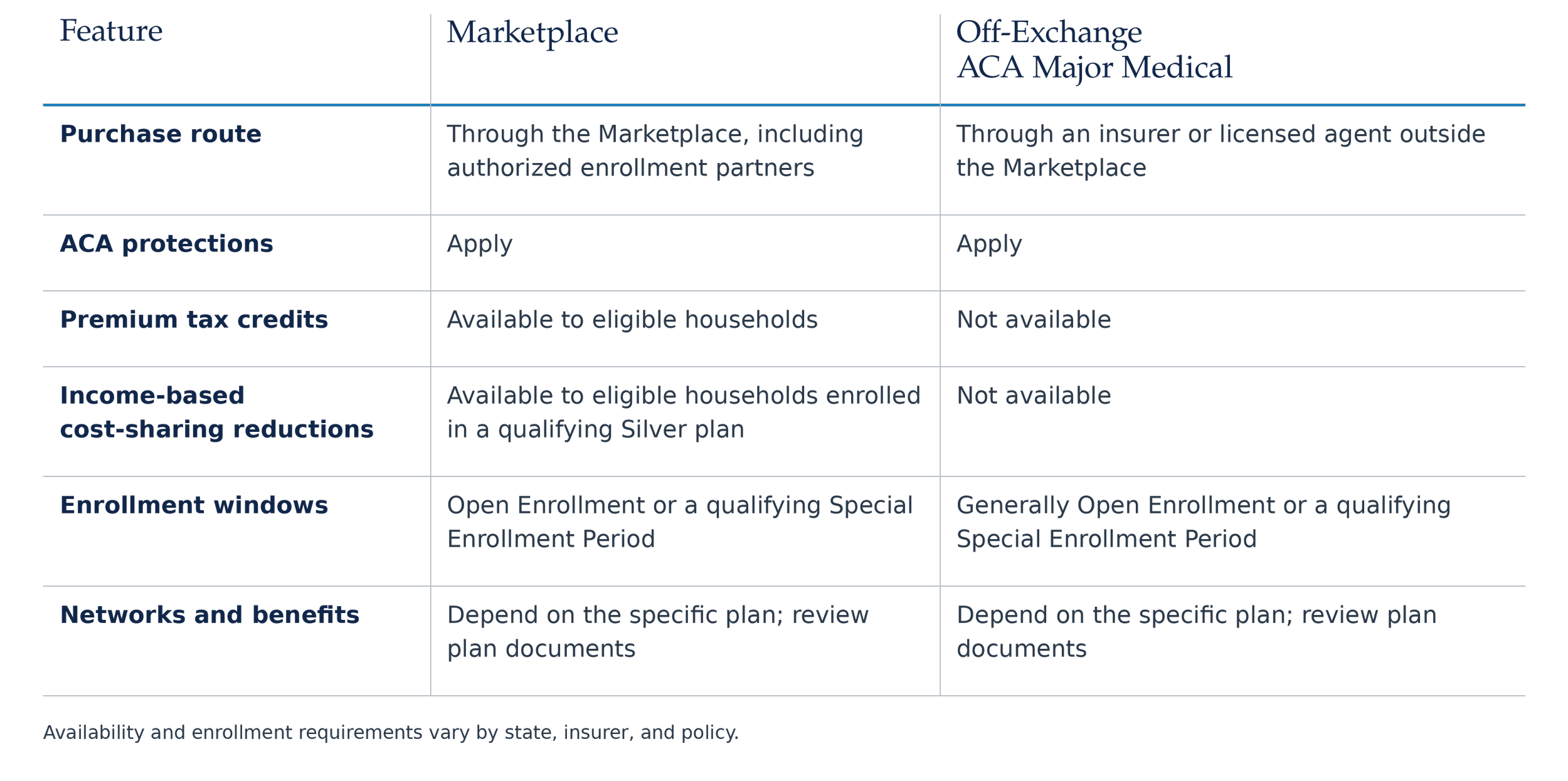
Both paths: Depend on the specific insurer, product, service area, and policy. Compare the actual plan documents.
Who might consider an off-exchange plan?
People purchasing their own coverage may want to compare off-exchange plans when they expect to pay the full premium, have a particular insurer or network in mind, or want to review plans offered directly in their area. This can include self employed individuals, households without employer coverage, and people changing jobs.
Those circumstances are reasons to compare, not proof that off-exchange coverage is the better choice. Marketplace plans can also be purchased at full price. An expected change in household income or access to other coverage may affect which enrollment path makes sense.
How to compare plans and enroll
Check your providers. Verify doctors, hospitals, and specialists in the specific plan’s network.
Review prescriptions. Check drug lists, pharmacy networks, cost tiers, and authorizations.
Compare total costs. Review premiums, deductibles, copayments, coinsurance, and applicable out-of-pocket limits.
Confirm the transition. Verify eligibility, the effective date, and the first premium payment before relying on the new policy.
Frequently asked questions
-
No. Premium tax credits require eligible coverage enrolled through the Marketplace.
-
Not necessarily. Verify your providers against the exact plan.
-
Not necessarily. Compare actual premiums, benefits, and any Marketplace assistance you may qualify for.
-
ACA-compliant individual coverage generally follows enrollment windows. Qualifying circumstances may allow special enrollment.
This page describes ACA-compliant individual and family major medical insurance purchased outside the Marketplace. Availability, eligibility, benefits, networks, and enrollment requirements vary by state, insurer, and policy. Premium tax credits and income-based cost-sharing reductions are not available on off-exchange coverage. Review the Summary of Benefits and Coverage, provider directory, formulary, and policy documents before enrolling.